Do Horses Really Live in the Present Moment? The Truth About Equine Memory and Behavior
The Myth of the Present Moment
There is a phrase passed around the horse world like gospel.
“Horses live only in the present moment.”
It is repeated so often that it begins to feel like the truth. The phrase carries a certain elegance. It sounds peaceful. It sounds spiritual. It sounds simple and reassuring.
But simplicity is not always accuracy.
This idea has become deeply embedded in conversations about horsemanship, equine-assisted programs, and even therapeutic models involving horses. It is often used to explain the clarity horses bring to human emotional experiences. While the phrase contains a grain of truth, it is also incomplete in ways that can significantly influence our interpretation of equine behavior.
When a belief is repeated long enough, it quietly shapes practice. It shapes how people train horses, how they interpret reactions in the arena, and how facilitators assign meaning to equine responses during human interactions.
When we accept the idea that horses live only in the present moment, we risk overlooking an essential reality of equine biology.
Horses remember.
And the memory held within their bodies directly influences how they respond to the world around them.
Understanding this distinction matters. It affects training decisions, welfare considerations, and the ethical use of horses in therapeutic or educational settings.
So it is worth examining the idea more carefully.
The Reality
Horses are undeniably more present-centered than humans. They do not sit in a stall replaying yesterday’s ride or worrying about what might happen tomorrow. They do not create internal narratives about social interactions or mentally rehearse future outcomes.
Humans often experience the present moment through layers of interpretation, expectation, and storytelling. Horses operate differently.
However, being present-centered does not mean living exclusively in the present moment.
Research in equine cognition and learning demonstrates that horses possess what scientists refer to as episodic-like memory. This type of memory allows animals to remember specific experiences along with the emotional tone associated with those experiences.
In practical terms, this means horses retain information about
• people
• environments
• handling patterns
• emotionally significant events
Scientific studies have demonstrated that horses remember both positive and negative interactions with humans and adjust their future behavior accordingly.
For example, research published in the journal Animals showed that horses can recognize and remember human facial expressions. Horses exposed to angry facial expressions later behaved more cautiously toward those individuals, even when the expression was no longer present.
Additional research published in Behavioural Processes indicates that horses retain the emotional impact of negative handling experiences for months after the event occurred.
These findings demonstrate an important point.
Equine behavior does not emerge randomly in isolated moments. Present responses are often shaped by associations formed through previous experiences.
Horses do not recall events through language or storytelling the way humans do. Instead, their bodies store sensory and emotional information.
When a situation resembles something previously experienced, the nervous system prepares the body before conscious interpretation occurs.
This preparation can include
• increased muscle tension
• changes in breathing rhythm
• heightened attention
• shifts in posture or movement
In other words, the body recognizes patterns before the mind explains them.
The Neurobiology of Memory in Horses
To fully understand why horses cannot be described as living only in the present moment, it is helpful to examine how memory is processed in the brain and body. Like all mammals, horses possess neural structures responsible for encoding experience, detecting threat, and storing emotional memory.
Three biological systems play a central role in this process.
The hippocampus
The hippocampus is responsible for forming and organizing memory related to events, locations, and context. In horses, the hippocampus helps encode environmental experiences and allows the animal to recognize places, routines, and individuals over time. This is one reason horses remember specific arenas, trail routes, feeding schedules, and handling patterns long after the initial experience occurred.
The amygdala
The amygdala plays a critical role in emotional learning and threat detection. When a horse encounters a stressful or frightening event, the amygdala rapidly links sensory information with an emotional response. This process allows the horse to remember danger and respond quickly if a similar stimulus appears again in the future.
Because horses are prey animals, this system is highly developed. Rapid recognition of potential threats is essential for survival. Once the amygdala associates a sound, object, or environment with fear, the body can react before conscious processing occurs.
The autonomic nervous system
Emotional memories are not stored only in the brain. They are distributed throughout the body through the autonomic nervous system. Sensory cues such as sound, vibration, smell, and movement can trigger physiological responses including changes in heart rate, muscle tension, breathing patterns, and attention.
This type of memory is often referred to assomatic memory, meaning the body remembers experiences through sensation.
When a horse encounters a stimulus that resembles a past event, the nervous system can activate a defensive or protective response even if no immediate threat exists. This is why horses sometimes react strongly to objects, environments, or sounds that appear harmless to human observers.
These responses are not irrational. They are the result of a biological system designed to protect the animal by remembering what has previously signaled danger.
Understanding these neurological processes helps explain why past experiences remain active within the horse’s present moment responses. The horse is not reliving the past in a narrative sense. Instead, the nervous system is recognizing familiar patterns and preparing the body accordingly.
Recognizing the biological foundations of equine memory encourages a more informed and compassionate approach to training and facilitation. When trainers and facilitators understand how experience is stored in the nervous system, they are better able to interpret behavior accurately and create conditions that promote safety, trust, and learning.
Where the Myth Creates Problems
When the belief that horses live only in the present moment becomes dominant, it alters how people interpret equine behavior.
If reactions are assumed to occur only in the immediate moment, the influence of past experience is excluded from consideration. Behaviors that are actually linked to previous learning may instead be interpreted as willful or oppositional.
Several common misinterpretations arise from this assumption.
Fear may be labeled as disobedience.
Confusion may be interpreted as resistance.
Hypervigilance may be described as an attitude.
When this happens, the emotional accuracy of the interaction begins to erode.
In training environments, this can lead to escalating pressure. A trainer may increase demands under the assumption that the horse is refusing to cooperate. In reality, the horse may be responding to a memory encoded in its nervous system.
Triggers for these responses may include
• the sight of specific equipment
• a familiar handling pattern
• pressure applied in a particular location
• a specific area of the arena
• environmental sounds associated with past stress
When these cues appear, the horse’s nervous system may activate a learned response automatically.
This reaction is not defiance. It is pattern recognition.
Without acknowledging the role of memory, trainers may inadvertently apply more pressure precisely when the horse needs clarity and reassurance.
Implications in Therapeutic Settings
The same misunderstanding can appear in equine-assisted therapy and equine-facilitated learning environments.
In these settings, facilitators sometimes interpret every horse's reaction as symbolic of a participant’s emotional state. Horses absolutely respond to human tension, breathing patterns, and movement. However, assuming that every equine reaction reflects the human in the arena can lead to significant misinterpretation.
A horse reacting strongly to a sound, movement, or object may be responding to its own history rather than mirroring the participant.
Possible influences include
• accumulated stress from previous sessions
• environmental stimuli unrelated to the participant
• stored associations linked to past experiences
When these factors are ignored, facilitators may assign meaning where none exists or overlook legitimate welfare concerns affecting the horse.
Respect for the horse requires recognizing that equine responses always exist within the context of the horse’s own experience.
Horses Live Through Sensation and Memory
The equine nervous system processes experience primarily through sensation.
Every interaction leaves an imprint that influences how future events are interpreted. Horses remember what their bodies remember.
These memories are encoded through
• sensory input
• emotional intensity
• environmental context
• patterns of pressure and release
As a result, present moment behavior emerges from the interaction between past learning and current perception.
This is not a simplistic process. It is a sophisticated survival mechanism developed over millions of years as prey animals adapted to unpredictable environments.
Horses do not construct narrative explanations for events. Instead, they respond directly to sensory patterns.
Their reactions are guided by physiological recognition rather than conceptual reasoning.
This is one of the reasons horses can appear extraordinarily perceptive. They are not filtering information through complex mental stories. They are responding to patterns exactly as they are experienced.
Proof That Horses Do Not Forget
The influence of memory in horses becomes unmistakably clear when observing animals that have experienced significant stress or trauma.
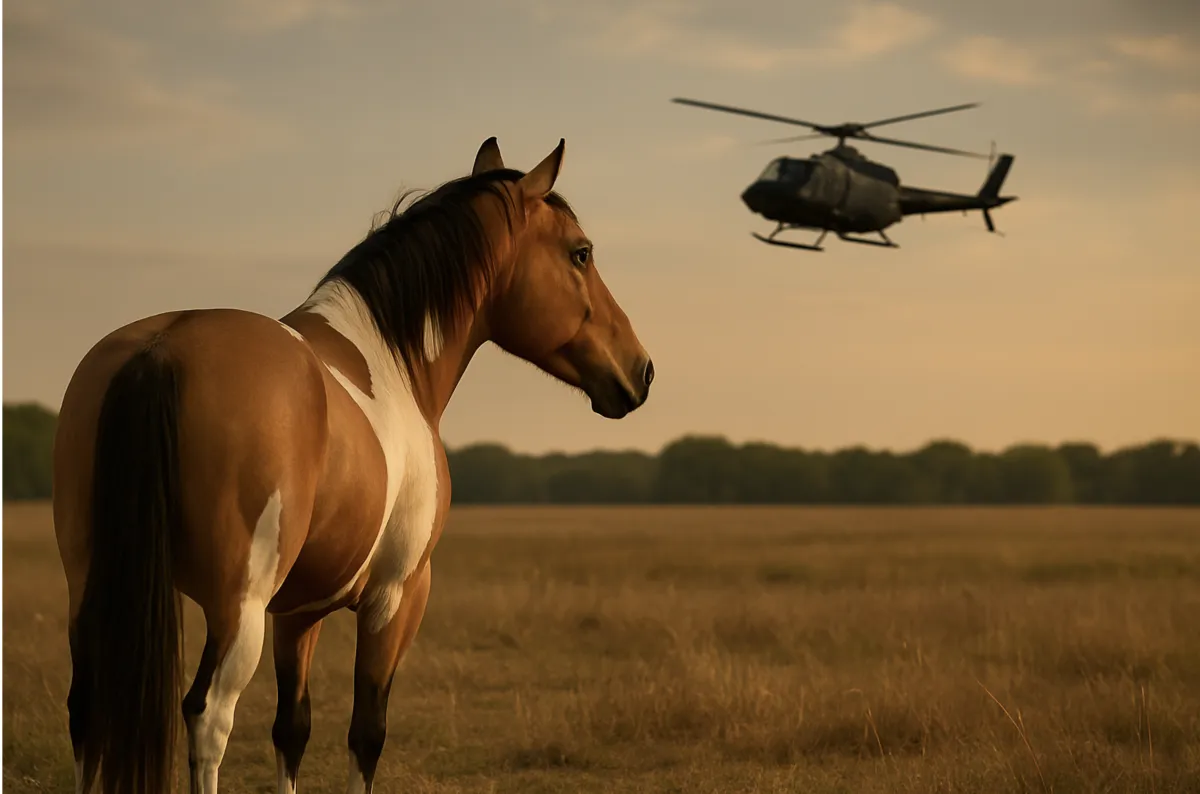
One of the most vivid examples I have witnessed involved our wild mustang, Montana.
Montana arrived at our sanctuary carrying the imprint of a difficult experience. Like many mustangs, he had been captured during a helicopter roundup, separated from his family band, and confined in an indoor holding pen for several months.
During that time, his world had been reduced to restriction and uncertainty.
When he arrived, his defensive responses toward humans were not random. They were survival strategies shaped by previous experience.
Trust did not develop through technique alone. It required time, predictability, and a consistent environment for Montana’s nervous system to gradually recalibrate.
Then, one afternoon, an unmistakable demonstration of memory occurred.
Our sanctuary is located near an Air Force base, and a helicopter flew low across the property. The sound filled the air, and the vibration could be felt through the ground.
Montana froze.
His muscles tightened. His breathing shifted. His attention locked onto the sky.
The helicopter was not chasing him. Nothing in the present moment posed a threat.
But the sensory pattern matched something stored in his body.
In that instant, the past had entered the present.
This reaction was not storytelling or conscious recollection. It was the nervous system recognizing a familiar signal and preparing for danger.
Montana was remembering through sensation.
This type of response illustrates precisely how episodic-like memory functions in horses.
How Horses Anticipate What Comes Next
Another aspect of equine cognition that is often misunderstood is anticipation.
Horses are highly skilled at detecting patterns. Through repetition, they learn the sequences that precede specific events.
Once these associations are established, the horse’s body begins preparing before the cue is consciously delivered.
Examples of this pattern recognition include
• walking toward the gate shortly before feeding time
• preparing for a specific lead change at a familiar location in the arena
• shifting posture when a rider adjusts rein contact
• lowering the head or slowing breathing when a participant approaches a therapy horse
Scientific research on equine learning consistently demonstrates that horses form strong associations between environmental cues and outcomes.
What appears to be extraordinary intuition is often the result of precise experiential learning.
The horse recognizes the pattern and prepares accordingly.
Why This Matters for the Equine Industry
The equine world is undergoing an important shift. Increasing numbers of trainers, riders, and facilitators are exploring trauma-informed approaches to horsemanship and emphasizing relationship-based training methods.
However, persistent myths about equine cognition can still influence practice in ways that limit understanding.
The belief that horses live only in the present moment oversimplifies a species that is remarkably perceptive and emotionally responsive.
Recognizing the role of memory and pattern recognition encourages several important changes.
Training becomes more observational and less force-driven.
Facilitation becomes more accurate and ethically grounded.
Behavior is interpreted within context rather than judged in isolation.
When trainers and facilitators acknowledge the horse’s learning history, they are better equipped to create environments that promote trust and clarity.
Final Thoughts
When we allow ourselves to see horses as they truly are, something profound shifts in the relationship.
Horses are not frozen in the present moment, nor are they empty vessels waiting to deliver lessons to humans. They are sentient beings with histories, memories, associations, and nervous systems that respond to life with remarkable honesty.
Acknowledging this does not complicate the horse. It liberates them. It frees us from expecting them to forget what has shaped them or behave as though they have been untouched by the experiences that came before us.
Recognizing the role of memory invites us into a partnership grounded in truth rather than myth.
When we honor the memories their bodies hold, we create the conditions for safety.
When we respect their anticipation, we become more thoughtful about the patterns we create.
When we interpret their reactions within the context of lived experience, we become better trainers, better facilitators, and better partners.
Horses are not asking for perfection. They are asking for presence, patience, and the willingness to see them clearly.
The horses who stand beside us carry the imprint of everything they have survived and everything they have learned. They offer honesty without filter and presence without pretense.
When we meet them with that same sincerity, the partnership deepens in ways technique alone can never achieve.
And that is where the real work begins.
Join the Conversation
Thank you for taking the time to read this post! I'd love to hear your thoughts, questions, or experiences. Feel free to share them in the comments below. If you found this blog helpful, please share it with fellow equestrians who might benefit from these insights. Together, we can build a more compassionate and connected equine community! 🐴✨
Connect
If you're inspired to 𝗱𝗲𝗲𝗽𝗲𝗻 𝘆𝗼𝘂𝗿 𝗰𝗼𝗻𝗻𝗲𝗰𝘁𝗶𝗼𝗻 with your horse and explore more tools for harmony and growth, click here to join our FREE Equine Wisdom Institute community on Skool! It's a supportive space for 𝗹𝗶𝗸𝗲-𝗺𝗶𝗻𝗱𝗲𝗱 𝗲𝗾𝘂𝗲𝘀𝘁𝗿𝗶𝗮𝗻𝘀 𝘁𝗼 𝘀𝗵𝗮𝗿𝗲, 𝗹𝗲𝗮𝗿𝗻, 𝗮𝗻𝗱 𝗴𝗿𝗼𝘄 𝘁𝗼𝗴𝗲𝘁𝗵𝗲𝗿 on this incredible journey with our equine partners.
Join our list!
Click here to be notified of new blogs, trainings, and upcoming events.
References & Additional Resources
Supporting Research on Equine Memory, Learning, and Behavior
Scientific research in equine cognition and behavioral science continues to demonstrate that horses possess complex learning abilities, emotional memory, and sophisticated pattern recognition. The following studies provide insight into how horses process experience, remember interactions, and respond to emotional cues in their environment.
Baragli, P., Vitale, V., Paoletti, E., Sighieri, C., & Reddon, A. R. (2021).
Horses associate human facial expressions with emotional memories.Animals, 11(4), 897.
This study demonstrated that horses can remember and respond differently to people based on previous emotional expressions, showing that horses retain emotional information linked to human interactions.
Lansade, L., Marchand, J., & Lormant, F. (2018).
Emotional memory in horses: Long lasting emotional responses to negative experiences.Behavioural Processes, 157, 99–106.
This research showed that horses retain emotional responses to negative handling experiences for extended periods, demonstrating the presence of long-term emotional memory in equine behavior.
Merkies, K., McLean, A., & Sankey, C. (2019).
The application of learning theory in equitation science.Applied Animal Behaviour Science, 211, 1–9.
This paper reviews how horses form associations through reinforcement and experience, highlighting the importance of understanding learning theory when interpreting horse behavior and training responses.
Sankey, C., Henry, S., Gorecka-Bruzda, A., Richard-Yris, M. A., & Hausberger, M. (2010).
The way to a man's heart is through his stomach: Food mediated positive reinforcement improves human–horse relationships.PLoS ONE, 5(11), e15446.
This research demonstrates that horses develop positive associations with humans through consistent reinforcement, further supporting the role of emotional learning in equine memory.
Visser, E. K., Van Reenen, C. G., Rundgren, M., Hassmén, P., Morgan, E., & Blokhuis, H. J. (2008).
Responses of young horses to novel objects and handling: Behavioral and physiological indicators of stress.Journal of Veterinary Behavior, 3(6), 228–237.
This study examined how horses respond to stress and unfamiliar stimuli, showing that physiological stress responses influence behavior and learning in equine environments.
Additional Supporting Research on Equine Cognition and Memory
Hanggi, E. B. (2005).
The thinking horse: Cognition and perception reviewed.Applied Animal Behaviour Science, 90(3–4), 209–224.
This widely cited review examines equine cognition, perception, and learning abilities, demonstrating that horses possess sophisticated memory systems and are capable of forming long-term associations between experiences, environments, and individuals.
Proops, L., Grounds, K., Smith, A. V., & McComb, K. (2018).
Animals remember previous facial expressions that specific humans have exhibited.Current Biology, 28(9), 1428–1432.
This study showed that horses remember the emotional expressions of individual humans and later adjust their behavior toward those people based on past interactions, providing strong evidence for long-term social memory in horses.
Sankey, C., Henry, S., André, N., Richard-Yris, M. A., & Hausberger, M. (2011).
Do horses have a concept of person? Recognition of humans based on familiar and unfamiliar cues.Behavioural Processes, 86(1), 85–90.
This research demonstrated that horses are able to recognize individual humans and remember previous interactions, supporting the idea that horses form lasting cognitive representations of people.
McGreevy, P., & McLean, A. (2010).
Equitation Science.Wiley-Blackwell.
This foundational text explains how horses learn through classical and operant conditioning, highlighting the role of experience, memory, and reinforcement in shaping equine behavior.
Hausberger, M., Roche, H., Henry, S., & Visser, E. K. (2008).
A review of the human–horse relationship.Applied Animal Behaviour Science, 109(1), 1–24.
This comprehensive review explores how horses form emotional associations with humans and environments, demonstrating that past experiences strongly influence equine responses and welfare.


