The Science Behind Soundness and Longevity in Horses
Why Starting Horses Under Saddle Too Young Can Harm Long-Term Soundness
The tradition of starting horses under saddle at two years old has long been accepted in several equestrian disciplines, especially in racing, reining, and Western performance horse industries. However, modern research in equine biomechanics, skeletal development, and veterinary sciencesuggests that riding horses too young can have serious long-term consequences for their soundness, performance, and overall health.
In this blog, we will explore the scientific reasons why starting a horse under saddle too early can be detrimental to longevity and performance. Using veterinary insight and research-based evidence, we will examine why delaying ridden work may be one of the best choices for a horse’s future.
The Science of Skeletal Maturity in Horses
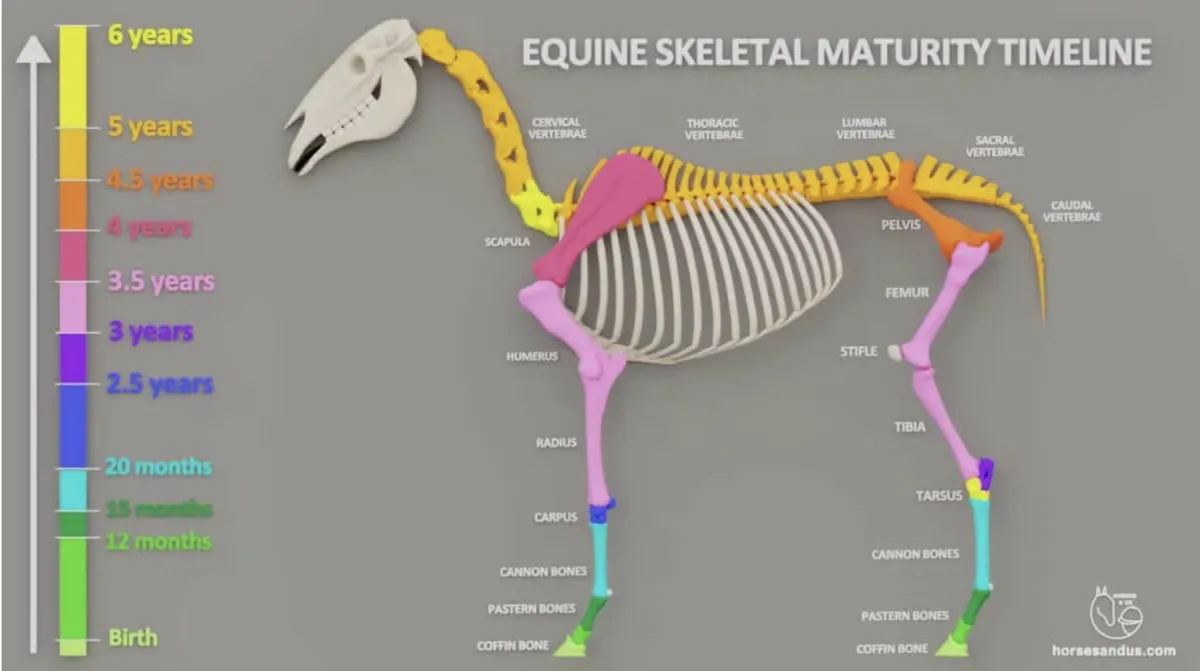
A horse’s skeleton develops in stages, with different growth plates, or physes, closing at different ages. Growth plates are areas of cartilage located near the ends of bones that eventually harden into mature bone. The earlier a horse is subjected to weight-bearing work, the greater the risk of damage to these still-developing structures.
Horses do not all mature at the same exact rate, and while many may appear physically grown by the age of two, their skeletons are still developing. Full skeletal maturity in horses is not reached until approximately 5.5 to 6 years of age, with the spine being one of the last structures to mature.
Equine anatomist Dr. Deb Bennetthas extensively studied skeletal maturation in horses. According to her research:
The last bones to mature are in thespine, and they do not fully close until at least 5.5 to 6 years old.
The vertebral growth plates, especially those in the neck and back, close much later than the limb bones.
The pelvis, another major weight-bearing structure, remains open until roughly 5 to 6 years of age.
Growth Plate Closure Timeline
Every bone in a horse’s body contains a growth plate that eventually hardens into mature bone. The earlier a horse is expected to carry a rider and saddle, the greater the risk of stressing these still-forming structures.
The most significant risks associated with riding young horses include:
Irreversible joint damage
Increased risk of osteoarthritis
Weakened tendons and ligaments leading to chronic lameness
Spinal issues affecting posture and biomechanics
Increased mental stress and anxiety may create behavioral problems
Key takeaway:the spine, which must support both saddle and rider, is thelast structure to fully mature. Riding a horse before the spine has fully developed can contribute to long-term back pain, poor posture, and irreversible damage to the vertebrae.
The Reality of Growth Plates
Many owners assume that because a horse looks mature on the outside, it must also be mature internally. But skeletal maturity in horses is not the same as outward appearance.
As Dr. Deb Bennett’s research highlights, different bones close at different ages, and the spinal column is the last structure to fully mature. Because the spine bears the weight of both saddle and rider, it is especially vulnerable to premature stress.
Here is the reality. A horse may look strong, athletic, and physically impressive at two or three years old, yet still have critical skeletal structures that have not finished developing.
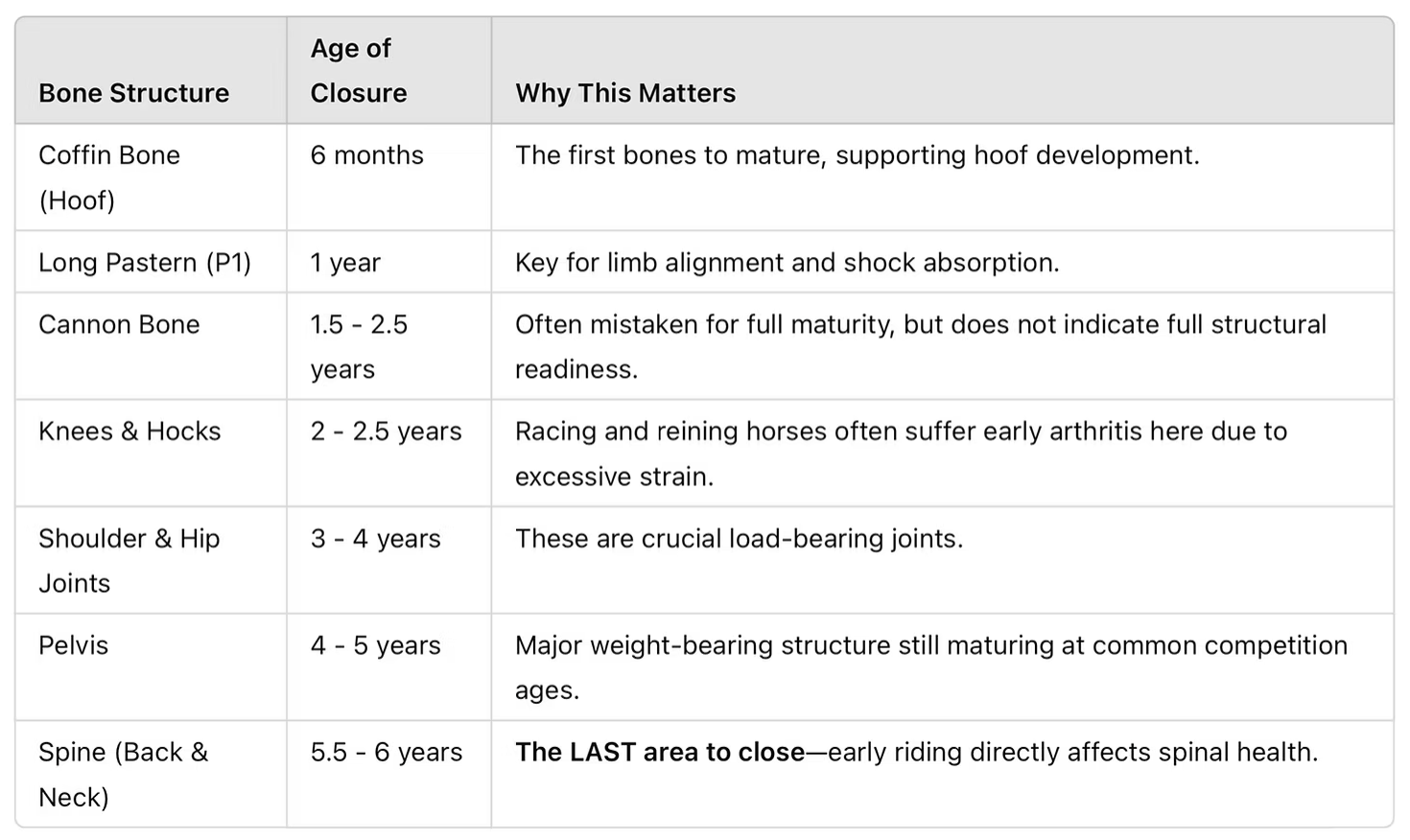
Here's an expanded look at the 𝘀𝗸𝗲𝗹𝗲𝘁𝗮𝗹 𝗰𝗹𝗼𝘀𝘂𝗿𝗲 𝘁𝗶𝗺𝗲𝗹𝗶𝗻𝗲:
Early Riding and Osteoarthritis
In young horses, the cartilage covering the ends of bones, known as articular cartilage, is not yet fully developed. That makes it more vulnerable to damage from repetitive weight-bearing and concussive forces.
A 2013 study published in the Journal of Orthopaedic Research found that excessive concussive force on immature joints accelerates cartilage wear, leading to early-onset osteoarthritis and degenerative joint disease later in life. Cartilage in young horses is particularly at risk because:
It has less density and resilience than mature adult cartilage.
It lacks the same level of lubrication and durability needed to withstand heavy workloads.
Repeated strain can create microfractures in the joint surface, leading to chronic inflammation.
A 2018 MRI study on Thoroughbred racehorses published in the Equine Veterinary Journal revealed that early training correlates with a higher incidence of subchondral bone microfractures and cartilage erosion, both of which can contribute to chronic lameness, joint inflammation, and reduced career longevity.
Horses that began intense training at two years old:
Werefour times more likelyto develop stress fractures.
Had significantly higher rates of arthritis before the age of five.
Had careers that lasted an average of 1.5 years shorter than horses started later.
In contrast, horses allowed to mature before entering heavy work develop stronger, more resilient cartilage and are less likely to experience premature joint disease.
Real-world example: Approximately 65 percent of Kentucky Derby horsesfrom 2000 to 2020 retired before age five due to joint-related issues. Meanwhile, dressage and eventing horses, which are usually started under saddle between four and six years old, often compete well into their late teens and twenties.
Why Tendons and Ligaments Are at Risk
Soft tissue structures such as tendons and ligaments also need time to mature. Unlike muscle, which adapts relatively quickly to exercise, tendons and ligaments require longer periods to strengthen and become resilient to repeated strain.
A study published in The Veterinary Journal in 2005 found that horses trained at two years old had significantly higher rates of tendon and suspensory ligament injuries than horses started later. This is because the collagen fibers in young tendons are still developing strength and elasticity.
Repeated stress from riding and trainingbefore tendons and ligaments are fully maturecan lead to:
Tendonitis
Suspensory ligament injuries
Greater risk of catastrophic breakdowns later in life
Delaying intense work allows these structures to adapt gradually, thereby reducing the risk of soft tissue injury.
A study on Standardbred racehorses published inVeterinary Surgery found that 80 percent of suspensory ligament injuries occurred in horses trained before skeletal maturity.
Real-world example: One of the most common injuries in young reining horses is suspensory ligament strain, which often results in career-limiting or career-ending lameness. By contrast, dressage and endurance horses that were started later tend to have lower rates of serious soft-tissue injuries.
The Missing Piece: Mental and Neurological Maturity
Beyond physical development, a horse’s neurological, mental, and emotional maturity also matters. Two-year-old horses are still in a juvenile stage of brain development, which can make it more difficult for them to process stress, learn new tasks, and regulate emotional responses.
A 2020 study published inApplied Animal Behaviour Sciencefound that horses started later, betweenfour and six years old, showed:
Lower stress levels, as measured by cortisol
Better learning retention
Stronger problem-solving abilities
By comparison, horses started attwo years oldshowed:
Significantlyhigher cortisol levels
Higher rates ofanxiety and stress-related behaviors, including weaving, cribbing, and bucking
Real-world example: Many professional trainers have observed that horses started too early often develop behavioral resistance as they mature.
This can show up as:
Ulcers and stress colicrelated to training pressure
Shutdown responses, often described as learned helplessness
Increased spookiness and reactivitydue to undeveloped neural pathways and chronic stress
Horses that are mentally mature before being introduced to ridden work are often more confident, less anxious, and better able to form trusting relationships with their handlers.
Why Waiting Pays Off
Across disciplines, the horses with the longest and soundest careers are often those started later and conditioned more gradually. Horses introduced to age-appropriate work tend to maintain soundness, willingness, and performance for many more years than horses rushed into training too early.
The Data Speaks
When you compare disciplines with the longest average career spans, the pattern is clear. Horses started later often remain sounder for longer.
Racing Industry Data
Started at 2 years old
Average career length = 3 to 6 years
A 2018 analysis of Thoroughbred racehorses found that only 15 percentof horses raced at two years old were still competing at age five. Horses that did not begin racing until three or four years old had significantly better odds of still competing beyond five.
Reining Horse Data
Started at 2 years old
Average career length = 3 to 6 years
Reining horses commonly started at two often retire by six or seven years old due tohock arthritis and navicular changes.
Dressage and Show Jumping Data
Started at 4 to 6 years old
Average career length = 12 to 18 years
Dressage and show jumping horses, which are generally started later, often compete successfully into their late teens and even early twenties.
Endurance Horse Data
Started at 6 years and older
Average career length = 15 to 25 years
Gradual conditioning strengthens joints, tendons, and ligaments over time, reducing the risk of repetitive stress injuries and long-term lameness.
This strongly suggests thatdelaying ridden work does not reduce performance potential. In fact, it often preserves the horse’s ability to perform successfully for a much longer period.
What Can You Do Instead
If your goal is to help your horse develop properly while still engaging their mind and body, there are many productive alternatives to early riding.
Consider incorporating:
In-hand training, including liberty work, lateral movements, and thoughtful exposure to new experiences
Long lining and ground driving
Gentle hill work and turnout for natural conditioning
Body awareness exercises over poles and obstacles
Building trust and communication without adding physical strain to the back and joints
These activities help young horses develop balance, coordination, confidence, and communication without the added risk of premature saddle work.
Patience Leads to Soundness
The science is clear. Starting a horse under saddle at two years old is not in the horse’s best long-term interest. While a young horse may be physically capable of performing certain tasks, their skeleton, joints, tendons, ligaments, and nervous system are still developing.
That means the risk of injury, chronic pain, early arthritis, behavioral stress, and shortened career length is significantly higher.
A well-developed horse is a sound horse. And a sound horse is one that can remain your partner for years to come.
By waiting until at least four to five years old before introducing ridden work, you give your horse the best possible chance for a long, healthy, willing, and successful career.
Final Thoughts
In the horse world, tradition often moves faster than science. For decades, starting horses under saddle at two years old has been considered normal in many disciplines. But modern research in equine biomechanics, veterinary medicine, and behavioral science is making something increasingly clear: a horse’s body and mind need time to mature before being asked to carry a rider.
When we rush a horse into work before their spine, joints, tendons, and nervous system are ready, we are often trading short-term performance for long-term soundness. The most successful horses across disciplines are rarely the ones started the earliest. They are the ones given the time to develop strength, coordination, and confidence before the demands of ridden work begin.
Patience in the early years pays dividends later. A horse allowed to mature physically and mentally is more likely to remain sound, willing, and capable of performing for many more years.
If we truly want longevity, partnership, and performance, the question may not be how early a horse can be started, but rather how wisely we choose to wait.
Join the Conversation
Thank you for taking the time to read this post! I'd love to hear your thoughts, questions, or experiences. Feel free to share them in the comments below. If you found this blog helpful, please share it with fellow equestrians who might benefit from these insights. Together, we can build a more compassionate and connected equine community! 🐴✨
Connect
If you're inspired to 𝗱𝗲𝗲𝗽𝗲𝗻 𝘆𝗼𝘂𝗿 𝗰𝗼𝗻𝗻𝗲𝗰𝘁𝗶𝗼𝗻 with your horse and explore more tools for harmony and growth, click here to join our FREE Equine Wisdom Institute community on Skool! It's a supportive space for 𝗹𝗶𝗸𝗲-𝗺𝗶𝗻𝗱𝗲𝗱 𝗲𝗾𝘂𝗲𝘀𝘁𝗿𝗶𝗮𝗻𝘀 𝘁𝗼 𝘀𝗵𝗮𝗿𝗲, 𝗹𝗲𝗮𝗿𝗻, 𝗮𝗻𝗱 𝗴𝗿𝗼𝘄 𝘁𝗼𝗴𝗲𝘁𝗵𝗲𝗿 on this incredible journey with our equine partners.
Join our list!
Click here to be notified of new blogs, trainings, and upcoming events.
References & Additional Resources
Bennett, D. (2008).Timing and Rate of Skeletal Maturity in Horses.
Dr. Deb Bennett, an equine anatomist, conducted extensive research on skeletal development in horses, showing that different bones mature at different rates. Her work demonstrates that the spine is the last structure to fully mature, often not closing until 5.5 to 6 years old, making early riding a significant risk factor for long term back issues and structural imbalance.Jeffcott, L. (2006).Osteochondrosis in the Horse: Pathophysiology and Long term Effects.Equine Veterinary Journal.
This study explores osteochondrosis, a developmental orthopedic condition caused by abnormal cartilage formation in young horses. Jeffcott found that high impact exercise before skeletal maturity contributes to joint deterioration, increasing the risk of osteoarthritis, joint deformities, and early retirement from competition.Smith, R. K. W. et al. (2005).Tendon Adaptation and Injury in Young Horses.The Veterinary Journal.
This research examines the slow adaptation of equine tendons and ligaments and shows that early training before full skeletal maturity leads to weaker connective tissues that are more prone to injury. The study found that while muscles strengthen relatively quickly, tendons and ligaments take much longer to mature, making early intense workloads a major contributor to suspensory and tendon injuries.Harris, P. et al. (2013).Effects of Early Training on Joint Development.Journal of Orthopaedic Research.
Harris and colleagues analyzed the long term effects of starting horses under saddle at a young age using MRI scans and joint analysis. Their findings showed that horses trained too early had significantly higher rates of microfractures, joint inflammation, and cartilage damage, all of which contribute to early onset arthritis and reduced athletic longevity.McGreevy, P. et al. (2020).Learning and Emotional Development in Young Horses.Applied Animal Behaviour Science.
This study examined the neurological and emotional effects of early training in horses. Researchers found that horses started under saddle too early showed higher cortisol levels, reduced problem solving ability, and increased anxiety related behaviors such as cribbing and weaving. The study concluded that waiting until horses are mentally mature improves learning retention and reduces stress related behaviors.
Together, these sources reinforce the conclusion that starting horses under saddle too early can lead to significant long term physical and psychological consequences, while delaying ridden work supports stronger, healthier, and more mentally balanced equine partners.


