The Illusion of Safety in Equine Facilitation: How Control Can Quietly Block Connection
Equine-Assisted Learning, Facilitator Presence, and Nervous System Safety
Every facilitator is taught that safety is sacred. Yet beneath the calm surface of structure and protocol, a quiet truth often hides... our own fear of the unknown.
When our desire to keep everyone safe becomes the driving force, we may unknowingly close the door to the very transformation we seek to create. In this reflection, we will explore how over-managing the equine-human experience can harden the healing container and how returning to trust, presence, and nervous system coherence can restore the rhythm where authentic transformation happens.
The Illusion of Control in Equine-Assisted Work
In equine-assisted work, we talk constantly about safety. Physical safety. Emotional safety. Psychological safety.
It is the foundation of what we do. We build safe arenas, establish boundaries, and teach clients to engage with horses in ways that feel supported and non-threatening. This is both ethical and essential. Horses are powerful beings, and many of the people who come to work with them arrive carrying uncertainty, tenderness, or invisible wounds.
Yet there is another side to safety that we rarely explore. It is not only the absence of danger that matters but the fear of not being safe itself. When safety becomes something we cling to rather than something we create through trust and presence, it can quietly transform from protection into limitation.
“The nervous system cannot receive in protection mode.True safety begins inside the facilitator.”
Fear and the Facilitator’s Nervous System
Fear as Fate
There is a natural law that says our fear becomes our fate. What we fear most, we unconsciously create.
When a facilitator enters a session anchored in fear of something going wrong, that fear becomes the vibration in the space. The horse feels it before a single word is spoken, and the client responds to it without realizing why. What was intended as protection becomes a barrier to presence.
Neurologically, fear activates the body’s protective response. Muscles tighten. Breath shortens. Perception narrows. In this state, neither facilitator nor client can fully receive or connect. Healing requires openness, and openness is only possible when the nervous system feels safe enough to soften.
The Horse and the Human Nervous System
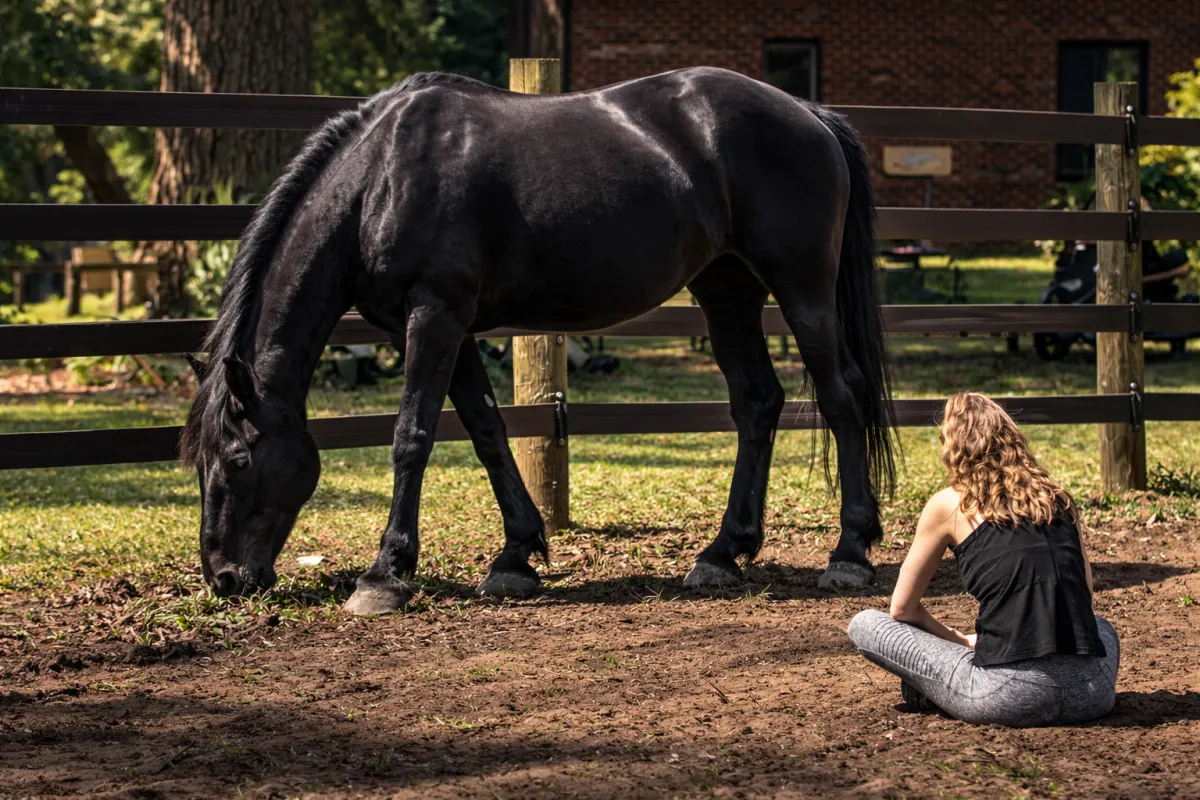
Horses are exquisitely attuned to the internal state of those around them.Research in equine-assisted therapy has shown that during interaction, the emotional and physiological states of horses and humans can become synchronized. This process, known as emotional transfer or physiological coupling, reveals that horses respond directly to the inner state of the human rather than their outward behavior.
When the facilitator’s nervous system is anchored in control or anxiety, the horse senses that truth and responds accordingly. What looks like unpredictability is often congruence. The horse is not unsafe. The horse is responding to what is real.
“When we become safety, the environment follows.”
When the Healing Container Hardens
When safety becomes our only focus, something subtle happens. The container that was meant to hold healing begins to harden. Sessions become overly structured and tightly managed. The facilitator’s nervous system becomes the gatekeeper rather than the conduit.
On the surface it looks like professionalism. Underneath, it blocks the natural movement of transformation.
True equine-assisted healing happens in the space of co-regulation and curiosity. Studies show that the calm and balanced nervous system of a horse can help regulate a human nervous system through resonance. But if the facilitator’s system is locked in control, that resonance cannot take place. The space may feel technically safe but emotionally inaccessible.
Compassion for the Facilitator
None of this means that safety is unimportant. Physical boundaries, ethical awareness, and risk management are sacred responsibilities.
The invitation is to notice the difference between creating safety and clinging to it.
When facilitators unconsciously carry fear, fear of being judged, fear of something going wrong, or fear of losing control, they may unintentionally disrupt the natural flow of connection. The energy of the session becomes filled with anticipation rather than trust. Horses then begin to stabilize what the human system cannot, often by holding tension or disengaging.
Safety, in its truest form, is not an external condition but an inner coherence. It arises when body, mind, and energy align in truth. Horses recognize this immediately. When the facilitator regulates their own nervous system and trusts the intelligence of the herd, the environment becomes safe because the human has become safe.
My First Training
I will never forget my very first EAL training. The facilitators had set up rows of chairs inside the arena, and the horses were at liberty. During one exercise, the horses began running through the rows of chairs.
One of the participants, a therapist, stood up, visibly shaken, and began shouting that the environment was unsafe and that the facilitators were being irresponsible.
The facilitators paused with deep compassion and asked her to share what she was experiencing inside her body. Through their gentle questions, she realized that the panic was not about the horses but about an old trauma that had never been fully processed. She had lived for years with the belief that she was not safe, and the running horses had awakened that memory.
As she shared, tears came, and the group held her as she released what she had carried for decades.
I left that training understanding that fear of safety often lives far deeper than the circumstances around us. Our role as facilitators is not to eliminate every unpredictable moment but to hold space for the meaning that arises when they occur.
When “Unsafe” Becomes Sacred
There have been a few times in my practice when a client experienced physical contact with a horse. Never intentional. Never careless. Yet every time, the outcome was profound.
A Client Story
A woman in her sixties came for a session while living with her adult son. During the session we were simply observing a horse standing quietly. Without warning, the horse bolted forward and shoulder-checked her to the ground.
She was physically unharmed, but the shock opened something inside her. Through tears she revealed that her son had been physically abusive and that she feared for her life. She had promised herself she would not talk about it that day, but the experience broke through the silence. We were able to connect her with resources that ultimately brought safety and freedom into her life.
A Facilitator Story
Another time, I was facilitating my largest corporate contract yet. The company owner warned me that one employee was particularly difficult. In the arena, it was immediately clear who he was. He was working with my red mare, ignoring her boundaries even as she clearly communicated that she needed space.
I was about to step in when my co-facilitator asked me a question. As I turned to respond, I heard a pop from across the arena. My mare had grazed the man’s knee with her hoof.
We stopped immediately and confirmed he was not seriously hurt. Although angry, he agreed to explore what this moment might mean. In that conversation, he realized that he had been living from a self-centered place that was damaging his relationships. His energy shifted entirely. The company owners stood speechless. That moment changed the course of his life.
A Volunteer’s Wake-Up Call
One of our veteran alumni had been volunteering in the barn for months, faithfully showing up to help with evening feed. One night, he came running to the house, shaken and limping. My Clydesdale, one of the gentlest souls I have ever known, had grazed his thigh with a back hoof. It made no sense. This horse had NEVER kicked.
When the veteran pulled up his pant leg, his inner thigh was completely black. His wife took him straight to the emergency room, where they ran an MRI. The doctors discovered a leaking blood vessel and told him he was within twenty-four hours of losing his leg.
He shared that he had been begging the VA for over a year to approve an MRI, but no one had taken his pain seriously. Standing in that hospital room, it was impossible not to feel the deeper truth moving underneath the surface of what had happened. I have to believe my horse knew. That gentle graze may have saved his life.
The Deeper Meaning of Safety in Equine-Assisted Healing
Safety is meant to be the foundation of healing, not the ceiling that limits it.
When we fear the unknown, we close the door on the intelligence that wants to move through the session. The law of nature reminds us that what we resist persists. If we fear chaos, we call it in. If we fear unpredictability, we attract it.
When we trust the intelligence of the system, the horse, the human, and the field, they begin to move together in harmony.
When the facilitator releases fear, the horse can return to its natural role as teacher. The energy softens. The space begins to breathe. Clients feel the shift. They sense the difference between being managed and being met.
In that moment, safety is no longer something constructed. It is something remembered.
“Safety is not the absence of risk. It is the presence of truth.”
Final Thoughts
Safety, Presence, and the Future of Equine Assisted Learning
In equine-assisted learning and equine-facilitated programs, safety will always remain essential. Horses are powerful animals, and responsible facilitators must prioritize physical safety, ethical boundaries, and thoughtful risk management. Yet the deeper work of equine-assisted services reminds us that true safety is not created by eliminating every unpredictable moment. It emerges when the facilitator’s presence, the horse’s awareness, and the client’s readiness align.
Horses are highly sensitive to the internal state of the humans around them. Research in equine-assisted therapy and horse-human interaction continues to show that horses respond to physiological and emotional signals long before humans consciously recognize them. Because of this, the facilitator’s nervous system, clarity, and emotional coherence often shape the tone of the entire session.
When facilitators overmanage the environment in an attempt to control every outcome, the equine-assisted experience can lose the natural rhythm that enables insight, curiosity, and transformation. The goal of safe equine facilitated work is not rigid control but grounded leadership. When facilitators regulate themselves, trust the horse's intelligence, and hold a container of calm awareness, horses often guide the learning process in powerful and unexpected ways.
The most meaningful breakthroughs in equine-assisted learning rarely come from perfectly managed moments. They arise when the horse-human relationship reflects something honest and alive in the present moment.
In that space, safety becomes more than a protocol. It becomes a shared rhythm between horse and human, where presence, trust, and awareness create the conditions for authentic transformation.
Join the Conversation
Thank you for taking the time to read this post! I'd love to hear your thoughts, questions, or experiences. Feel free to share them in the comments below. If you found this blog helpful, please share it with fellow equestrians who might benefit from these insights. Together, we can build a more compassionate and connected equine community! 🐴✨
Connect
If you're inspired to 𝗱𝗲𝗲𝗽𝗲𝗻 𝘆𝗼𝘂𝗿 𝗰𝗼𝗻𝗻𝗲𝗰𝘁𝗶𝗼𝗻 with your horse and explore more tools for harmony and growth, click here to join our FREE Equine Wisdom Institute community on Skool! It's a supportive space for 𝗹𝗶𝗸𝗲-𝗺𝗶𝗻𝗱𝗲𝗱 𝗲𝗾𝘂𝗲𝘀𝘁𝗿𝗶𝗮𝗻𝘀 𝘁𝗼 𝘀𝗵𝗮𝗿𝗲, 𝗹𝗲𝗮𝗿𝗻, 𝗮𝗻𝗱 𝗴𝗿𝗼𝘄 𝘁𝗼𝗴𝗲𝘁𝗵𝗲𝗿 on this incredible journey with our equine partners.
Join our list!
Click here to be notified of new blogs, trainings, and upcoming events.
References & Additional Resources
Supporting Research on Equine Assisted Therapy, Human–Horse Interaction, and Nervous System Regulation
Beetz, A., Uvnäs-Moberg, K., Julius, H., & Kotrschal, K. (2012).
Psychosocial and psychophysiological effects of human–animal interactions: The possible role of oxytocin.Frontiers in Psychology, 3, 234.
Demonstrates that authentic human–animal connection influences emotional regulation, bonding, and stress reduction through oxytocin release.
Gehrke, E. K., Baldwin, A., & Schiltz, P. M. (2011).
Heart rate variability, health, and horsemanship.Journal of Equine Veterinary Science, 31(2), 78–84.
Explores heart rate variability as a measure of physiological coherence between horse and human, showing how calm leadership can influence both nervous systems.
Lipton, B. H. (2005).
The Biology of Belief: Unleashing the Power of Consciousness, Matter and Miracles.Hay House.
Explains how perception and belief influence cellular behavior, supporting the idea that fear-based focus can influence biological responses.
Pendry, P., & Vandagriff, J. (2019).
Human–horse heart rate synchrony during equine assisted services for trauma-exposed youth.Journal of Equine Veterinary Science, 79, 103–112.
Finds that horse and human heart rhythms can synchronize during therapy sessions, suggesting physiological co-regulation and shared emotional states.
Porges, S. W. (2011).
The Polyvagal Theory: Neurophysiological Foundations of Emotions, Attachment, Communication, and Self-Regulation.W. W. Norton & Company.
Introduces the concept of neuroception and explains how the nervous system detects safety or threat, providing a framework for understanding co-regulation in healing environments.
Siegel, D. J. (2012).
The Developing Mind: How Relationships and the Brain Interact to Shape Who We Are.Guilford Press.
Explores how interpersonal attunement and nervous system resonance shape emotional regulation and psychological development.


